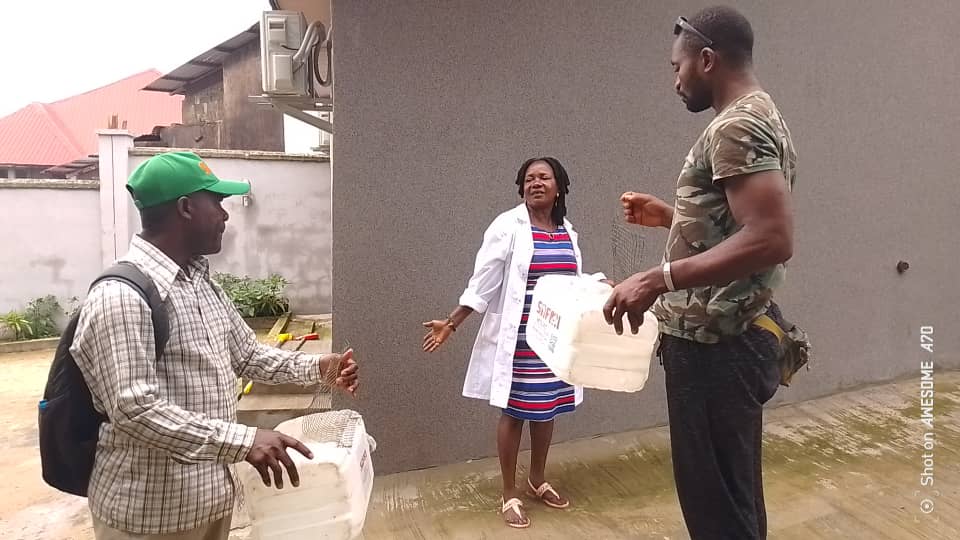
At SAFMI, our work does not end when a water tank with Gambusia fish is delivered. Every tank placed in a hospital, school, university, public space, or household becomes part of a wider learning process. To build a credible and scalable malaria-prevention model, we are developing and testing different frameworks to understand how our tanks may affect mosquito populations, malaria cases, and community awareness.
Our approach combines international experience with local data. We study previous examples of Gambusia fish being used in other countries as a biological method to reduce mosquito larvae in standing water. These studies help us form our own theories about suitable conditions for the fish, effective maintenance practices, tank density, and possible indicators of success. However, Sierra Leone has its own environmental and healthcare realities, so our framework must be tested carefully and adapted to the local context.
One of the key parts of our assessment is the use of statistics from the National Malaria Control Programme operationg on behalf of the Ministry of Health in Sierra Leone. We aim to compare this information with SAFMI’s operational data, such as the number of water tanks placed per 1 square kilometre or within smaller zones such as 100 square metres. This helps us explore whether higher tank density may be linked to changes in mosquito activity or malaria-related outcomes.
At this stage, we are still testing our theories and refining our methods. Malaria is influenced by many factors, including rainfall, population density, testing rates, healthcare access, bed net usage, and sanitation. For this reason, SAFMI uses both quantitative and qualitative methods. Quantitatively, we look at correlations between tank distribution, mosquito presence, and malaria statistics.
Qualitatively, we collect feedback, observations, and case studies from hospitals, schools, families, and communities. These stories are essential. A hospital may report fewer mosquitoes on its premises. A school may describe how children learn from the tanks. A family may explain how caring for the fish becomes part of daily life. Together, these experiences help us understand the reality behind the numbers and improve our assumptions over time.
By combining statistical analysis with community experience, SAFMI aims to create a clearer picture of impact. Our goal is not only to show where we have worked, but to understand how our initiative can be improved, expanded, and eventually used as an example for other regions. Each tank, each data point, and each story brings us closer to a stronger model for sustainable malaria prevention. This framework reflects SAFMI’s commitment to transparency, learning, and evidence-based action. We believe the future of malaria prevention must be built not only on hope, but also on knowledge, responsibility, careful testing, and measurable progress.
.png)
.png)
.png)